
Reading Tarot Cards for Beginners:
How to Start
You have been drawn to the cards for a while. Maybe you picked up a deck and then put it back down. Maybe you have been watching others read tarot and wondering — could I do that too?
The answer is yes. Tarot is a language. And like any language, you learn it by starting — not by waiting until you feel ready.
This guide walks you through your first real steps into tarot: what you need, what to expect, and how to build a practice that actually works for you.
Step 1: Choose the right deck for you
The most important thing about your first tarot deck is that it speaks to you visually. You are going to spend a lot of time with these images, so they need to resonate.
For beginners, the Rider-Waite deck is the classic starting point. Almost every tarot book, course, and guide uses it as the reference point. The imagery is rich, symbolic, and consistent. Once you understand Rider-Waite, any other deck becomes easier to read.
But if another deck calls to you, trust that. Tarot begins with intuition, and your relationship with your deck starts before you ever draw a card.
A few things to look for:
- Each card has a distinct, illustrated scene (not just symbols or pips)
- The imagery feels meaningful to you — not just aesthetically pleasing
- A guidebook is included, especially helpful in the early stages
Step 2: Get to know the structure before you memorise anything
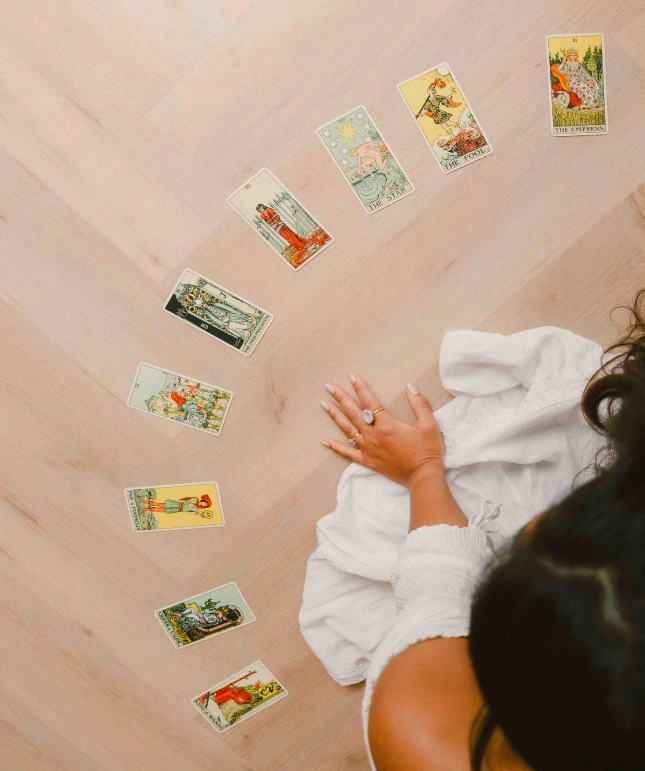
A standard tarot deck has 78 cards. Before you try to learn them all, understand how they are organised — because the structure itself tells you a great deal.
The Major Arcana (22 cards)
These represent the big themes of life: transformation, loss, hope, power, surrender. Cards like The Fool, The High Priestess, and The Tower show up when something significant is at play. When you draw a Major Arcana card, pay attention.
The Minor Arcana (56 cards)
These reflect everyday life — your thoughts, feelings, decisions, and circumstances. They are divided into four suits:
- Wands: fire energy, passion, ambition, creative drive
- Cups: water energy, emotions, relationships, intuition
- Swords: air energy, the mind, communication, conflict, clarity
- Pentacles: earth energy, the body, money, work, the physical world
Each suit runs from Ace to Ten, followed by four court cards: Page, Knight, Queen, King.
You do not need to memorise all 78 cards before you start reading. You need to understand the framework — and let the rest come with practice.
Step 3: Start with a single card, every day
The most effective practice for beginners is also the simplest: draw one card each morning.
Before you look up the meaning, hold the card. Look at the image. Notice what draws your eye first. Notice what feeling it creates in you. Ask yourself what you see before asking what it means.
Then look it up. Read the traditional meaning. And at the end of the day, come back to it. Did anything in your day connect to that card? Often, it did.
This daily practice does three things:
- It builds a personal relationship with each card over time
- It trains your intuition to respond before your mind analyses
- It shows you that tarot is not about memorisation — it is about pattern recognition
One card a day is enough. Consistency matters more than depth at this stage.
Step 4: Learn to trust what you see, not just what the book says
This is where most beginners get stuck. They draw a card, look up the meaning, and then override everything they felt before they opened the guidebook.
Tarot meanings are a starting point, not a verdict. The traditional meaning of a card shifts depending on the question, the context, and the energy of the moment. Two readers can draw the same card and see something completely different — and both can be right.
Your intuition is not a distraction from reading tarot. It is the whole point.
As you practise, you will start to notice:
- Certain cards keep appearing for you — pay attention to those
- Some images trigger an immediate feeling before you think; that feeling is data
- Your readings become more fluid when you speak what you see, not what you studied
Step 5: Know when to go deeper
Self-study will take you a long way. But there is a point in every beginner’s journey where the cards start to open up faster with structured guidance than with solo practice alone.
At SacredShe, the Discover the Art of Tarot course is built for exactly this moment. It takes you from the foundations — the 78 cards, the suits, the spreads — into the intuitive layer that makes tarot genuinely transformative. Not as a technique you perform, but as a language you speak naturally.
The course is designed for women who want to read tarot with real confidence: for themselves, for the people around them, and eventually as part of their own spiritual practice.
You already have what you need
The biggest myth about tarot is that you need a special gift to read it. You do not. You need curiosity, patience, and the willingness to trust what comes through. Start with one deck. Draw one card. See what it says.
Curious about tarot first? Read: What Is Tarot Reading? Everything You Need to Know
